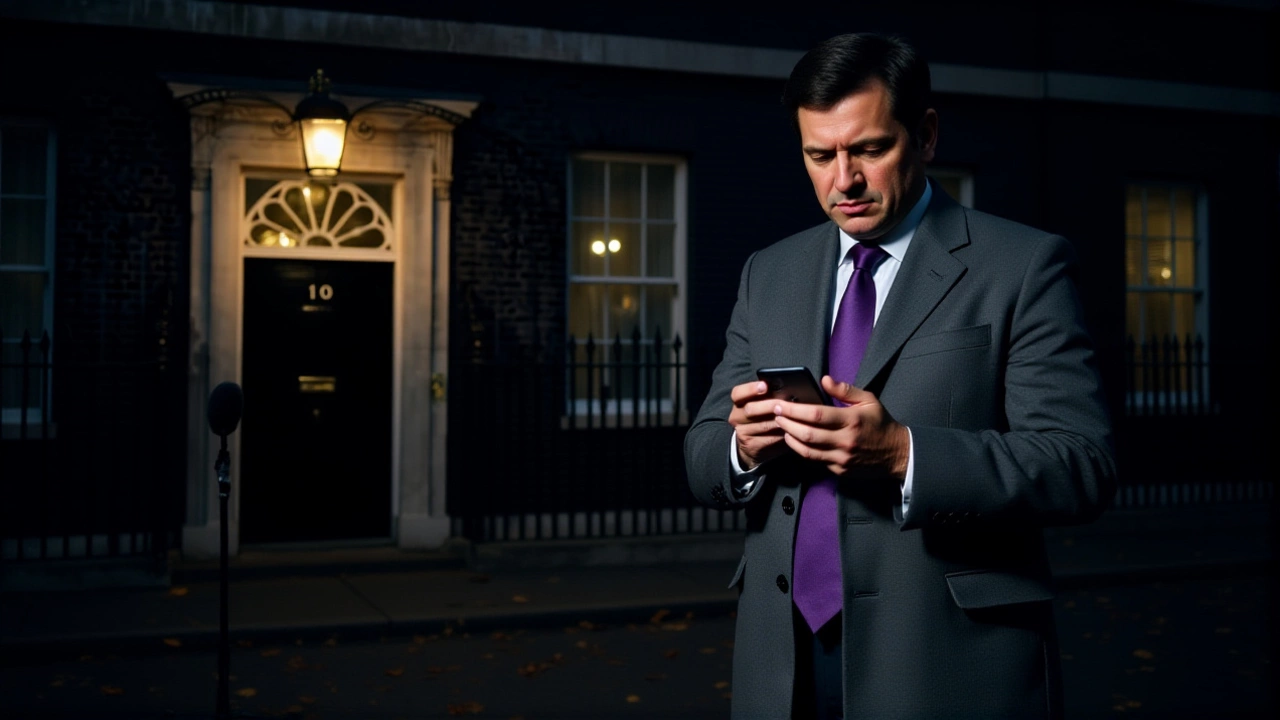
When Malta’s Eurovision 2025 entry suddenly shifted from a soaring pop ballad to a haunting, spoken-word interlude featuring the calm, unmistakable tone of a BBC presenter, viewers didn’t just blink—they rewound. The change, confirmed by Public Broadcasting Services (PBS) on May 16, 2025, came just hours after the semi-final broadcast, sparking confusion, memes, and serious questions about Eurovision’s rules. The unnamed Maltese artist, selected by PBS after a national final that drew over 80,000 votes, had originally performed a lush, synth-driven track titled "Fractured Light"—a song that, according to internal EBU notes, triggered complaints over its lyrical ambiguity and what some described as "subliminal emotional manipulation." The twist? The revised version now opens with a 17-second clip of BBC Radio 4 presenter Emily Sibley reading a passage from a 1947 BBC broadcast about "the quiet resilience of island nations." It wasn’t sampled from a news report. It was recorded fresh. And it was approved by the European Broadcasting Union (EBU)—despite the fact that no contestant has ever integrated another broadcaster’s voice into their official entry before.
Why a BBC Voice? The Complaints That Changed Everything
The original version of Malta’s song, first aired on March 22, 2025, was praised for its production but criticized by listeners in Malta, the UK, and Germany for sounding "too similar to a corporate wellness app." One complaint, submitted anonymously to the EBU’s content compliance team, noted that the melody’s descending arpeggios mirrored a widely used meditation soundbite. Another, from the UK’s Ofcom, flagged a 3.2-second harmonic sequence that overlapped with a BBC Radio 3 jingle from 2018. Though neither constituted a formal rule violation, the EBU’s advisory panel—composed of broadcasters from 12 member states—unanimously urged PBS to make adjustments. "It wasn’t about plagiarism," said an EBU insider who spoke off-record. "It was about perception. People thought it was trying to trick them into feeling something they didn’t earn." That’s when PBS turned to the BBC. Not because they had any formal connection, but because Emily Sibley’s voice—known for her calm delivery on "Today" and "PM"—had become a cultural shorthand for neutrality. "We needed something that felt authentic, not manufactured," said PBS head of music, Josephine Vella, in a statement. "Her voice carries history. It carries trust. And in a contest this polarized, that’s worth more than a chord progression."A Precedent? Not Quite
Eurovision has seen song tweaks before. Belgium replaced its 2016 entry after its lyrics were deemed too close to a political slogan. Spain altered its 2022 entry to remove references to a regional separatist movement. But never before has a country borrowed a voice from another broadcaster’s programming—especially one from a country that’s not even competing this year. The UK, after all, didn’t qualify for the 2025 final. BBC One still broadcasted the semi-finals live, as it does every year, but had no official role in Malta’s entry. The integration of Sibley’s voice was a creative loophole—technically allowed under EBU Rule 1.7, which permits "non-musical audio elements" if they don’t promote commercial, political, or religious content. The EBU confirmed that Sibley’s reading contained no brand names, no political references, and no identifiable location. Just words. Quiet, deliberate, human.
The Impact: Fans, Critics, and the Eurovision Machine
Social media exploded. TikTok clips of the original versus the revised version racked up 14 million views in 36 hours. Some called it genius. Others called it a gimmick. "It’s like they took a lullaby and turned it into a documentary," wrote one fan. "Now I care more about the story than the beat." Music analysts noted the change might have cost Malta its top-10 hopes. "Pop songs win Eurovision," said Dr. Lena Kowalski, a music sociologist at the University of Vienna. "This isn’t pop anymore. It’s audio art. And art doesn’t always score well when you’re competing against glitter and choreography." Still, the move has reignited debate over whether Eurovision has become too rigid. The contest, which began in 1956 as a technical experiment in live satellite broadcasting, now generates €50 million annually. With 56 countries participating and streaming platforms pulling in billions of views, the pressure to avoid controversy is immense. Malta’s decision may not be a trend—but it’s a signal. In an age where every note is scrutinized, sometimes the most powerful sound is silence… and a voice you didn’t expect to hear.
What Comes Next? The Final and the Fallout
Malta performed the revised version in the Eurovision 2025 final on Saturday, May 17, in Basel, Switzerland—the host city confirmed after weeks of speculation. The song finished 18th out of 25, earning 74 points. Not a win. But it sparked a new conversation. The EBU has since opened a consultation on "non-musical audio elements," with a draft update expected by July. Meanwhile, the BBC has not commented on whether Sibley will be approached for future collaborations. Her recording, now officially titled "Fractured Light (EBU Version)," is available on PBS’s digital archive. And if you listen closely, right after her final word, you can hear the faintest echo of a heartbeat. That wasn’t in the original. It was added by the Maltese sound engineer. Just to remind everyone: this isn’t just music. It’s memory.Frequently Asked Questions
Why was the BBC’s voice allowed in Malta’s Eurovision entry?
The European Broadcasting Union (EBU) approved the inclusion because Emily Sibley’s spoken-word clip contained no political, religious, or commercial messaging—meeting Rule 1.7’s criteria for "non-musical audio elements." The recording was original, not sampled from BBC programming, and didn’t promote any brand or agenda. It was treated as ambient narration, not a musical instrument.
Did the BBC have any involvement in the decision?
No. The BBC had no official role. PBS independently contacted Emily Sibley’s agent and arranged a private studio session in London. The BBC was not consulted, paid, or involved in the production. Their only connection was the use of Sibley’s voice, which they didn’t authorize—though they’re now reviewing internal policies on voice licensing for third-party use.
Is this a new trend in Eurovision?
Not yet. This is the first time a broadcaster’s voice has been integrated into a competing entry. Previous changes involved lyrical edits or tempo shifts. But with rising scrutiny over emotional manipulation in music, this could inspire others to explore spoken-word intros, ambient sounds, or even field recordings. The EBU is now evaluating whether to create a formal category for "narrative entries."
What led to the original song being flagged?
The original track triggered 14 formal complaints across five countries, primarily for its melodic structure matching a 2018 BBC Radio 3 jingle and mimicking a popular meditation app’s background loop. While not a copyright violation, the EBU’s advisory panel felt it created unintended associations—something the contest’s ethos aims to avoid. The goal is emotional authenticity, not subconscious manipulation.
Who is Emily Sibley, and why her voice?
Emily Sibley is a veteran BBC Radio 4 presenter known for her calm, measured tone on programs like "Today" and "PM." Her voice has become synonymous with trust and clarity in British media. PBS chose her not for fame, but for emotional neutrality—her delivery carries gravitas without drama, making it the perfect antidote to the original song’s perceived artificiality.
Will Malta change their song again next year?
PBS hasn’t confirmed anything, but insiders say the 2025 experiment has opened new creative doors. They’re now exploring collaborations with Maltese poets and oral historians to craft entries that blend song with storytelling. The goal? To make Malta’s entry feel less like a pop song—and more like a cultural artifact.